Should I choose an interest-only or principal and interest loan for investment?
Interest-only lowers investment loan repayments now but doesn't reduce your balance. How it compares with principal and interest, and what changes later.

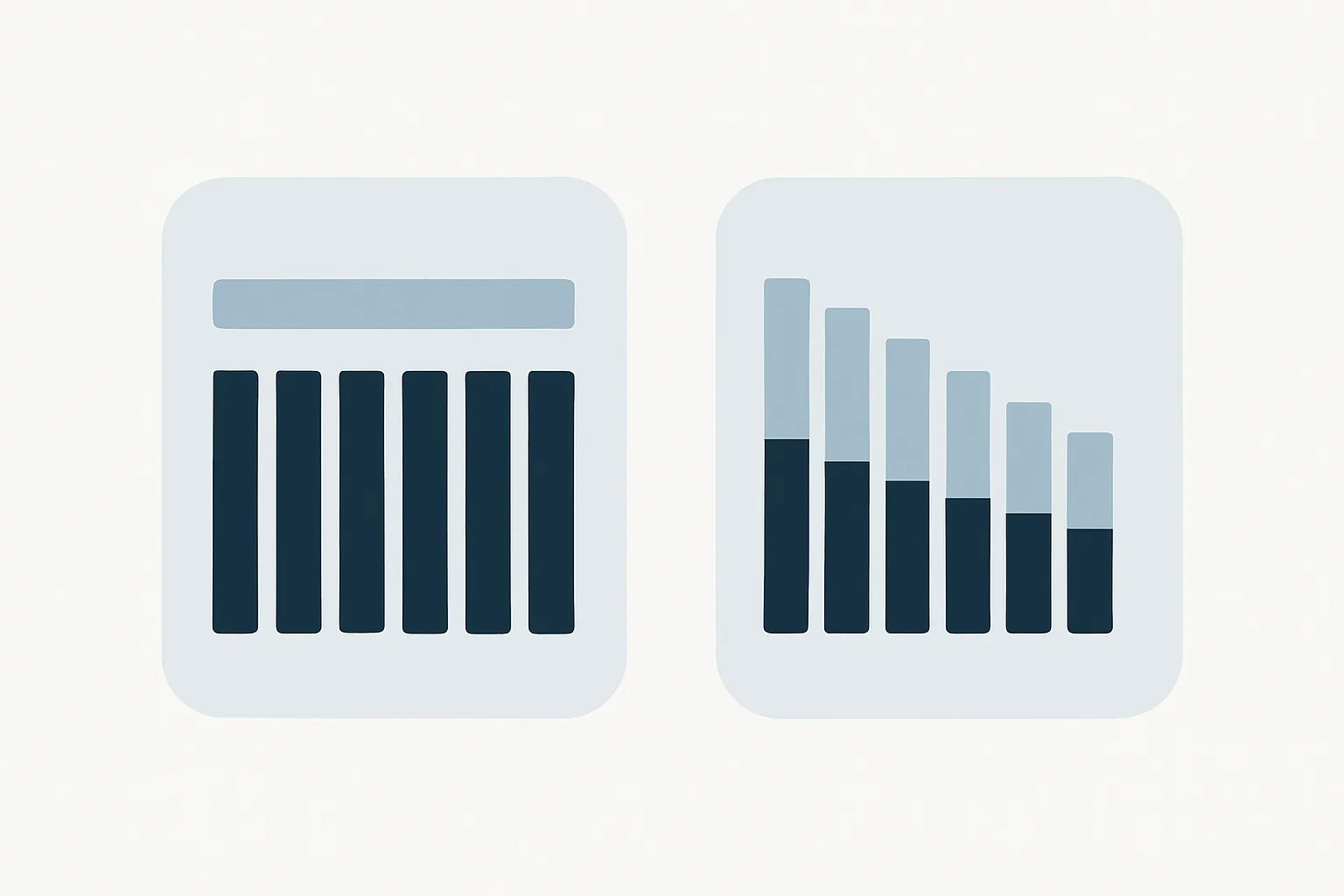
Should you choose interest-only or principal and interest for an investment loan?
There’s no single right answer here — the better fit depends on your cash flow needs, what you’d do with any freed-up money, and how you want your loan balance to move over time. Understanding what each repayment type actually does is the starting point.
With a principal and interest (P&I) loan, every repayment has two parts: interest charged on what you still owe, and an amount that reduces what you owe (the principal). Because the principal shrinks with each repayment, the loan balance falls over time and the loan works toward being paid off.
With an interest-only (IO) loan, repayments cover only the interest charged for a set period. None of the repayment reduces what you owe, so the loan balance stays the same throughout that period. Once the set period ends, repayments revert to principal and interest over the loan’s remaining term — the balance still has to be paid off, just over a shorter time than if you’d been on P&I from the start.
Both structures exist for owner-occupier and investment loans, but the choice comes up more often for investors, because interest-only repayments line up closely with how loan interest is treated for tax on a rental property — a point covered in detail below.
How do the two structures compare on the factors that matter?
| Factor | Interest-only | Principal and interest |
|---|---|---|
| Repayment amount during the set period | Lower — interest only | Higher — interest plus principal |
| Loan balance during that period | Stays the same | Reduces over time |
| Total interest paid over the life of the loan | Generally higher, because the balance the interest is calculated on stays higher for longer | Generally lower, because the balance — and so the interest charged on it — reduces sooner |
| What happens once the set period ends | Repayments step up when the loan reverts to P&I over the remaining term | No change — you’re already on the P&I trajectory |
| Equity built through repayments alone | None, until the loan reverts to P&I | Builds progressively from the first repayment |
This comparison assumes the same interest rate and loan amount apply under either structure — in practice, rates, fees and any rate changes during the loan term can move the actual numbers, and a figure specific to your loan comes from your lender’s own repayment schedule, not from this article.
Some investors choose interest-only to keep more cash free for other purposes — a cash buffer, another deposit, or simply matching repayments more closely to what a property earns in rent during a period when they expect other costs to be higher. Others choose principal and interest from the start because they want the loan balance falling immediately, without relying on a later switch. Neither choice is right or wrong in the abstract; it’s a trade-off between cash flow today and the loan balance over time, and a licensed mortgage broker or lender can model both scenarios against your actual numbers.
If you want to see how rental income stacks up against costs (including loan repayments) on a property you’re considering, our guide to calculating gross and net rental yield walks through both formulas.
Does the loan type change what you can claim as a tax deduction?
No — the same deductibility rule applies whichever structure you’re on: only the interest portion of a repayment can be a tax deduction on a rental property, never the principal. This surprises some investors weighing interest-only partly for tax reasons, so it’s worth being precise about it.
The ATO’s Rental properties guide defines negative gearing this way: “Negative gearing occurs when you buy a rental property with the assistance of borrowed funds and the rental income is less than the deductible expenses (including interest on the borrowings). The tax result of negatively gearing a property is that a net rental loss arises.” Under current law, “you may be able to claim a deduction for the full amount of rental expenses against your rental and other income… when you complete your tax return for the relevant income year. Where the other income isn’t sufficient to absorb the loss you can carry it forward to the next income year.” This is the settled position that applies now, for the 2026-27 income year.
Where the structures genuinely differ is in how the deductible interest amount moves over time. Because a P&I loan’s balance falls with every repayment, the interest charged on it — and so the deductible amount — tends to shrink as the loan matures. On an interest-only loan, the balance stays level during the set period, so the deductible interest amount stays level too, for as long as that period runs.
As at July 2026, there’s an enacted change on the horizon that’s worth knowing before you lock in a loan structure around negative gearing. Under the Treasury Laws Amendment (Tax Reform No. 1) Act 2026 (Act No. 49 of 2026, royal assent 26 June 2026), a new quarantine rule (s26-155 ITAA 1997) starts from the 2027-28 income year: residential rental deductions exceeding residential rental income will no longer be deductible against your other income — they can only be used against residential capital gains or carried forward against future residential rental income. Interests acquired before 7:30pm AEST on 12 May 2026 are grandfathered under the old rules.
That’s a distinct, later-starting rule from the negative gearing treatment described above, which is what applies right now — the two shouldn’t be conflated. Our guide to cash flow positive versus negatively geared property goes further into both.
Tax outcomes depend on your circumstances — speak with a registered tax agent before acting.
Does choosing interest-only change your borrowing power?
Not necessarily, and often not in the direction some investors expect. It’s a common assumption that lower interest-only repayments make a loan easier to qualify for — but APRA’s guidance to lenders (APG 223, Residential Mortgage Lending) points the other way for how serviceability is meant to be assessed: a prudent assessment “would incorporate the borrower’s ability to repay principal and interest over the actual repayment period” — meaning over the remaining P&I period once the interest-only period ends, not over the lower interest-only repayment itself.
That assessment sits inside a broader serviceability framework. Under Prudential Standard APS 220, “ADIs must apply a buffer over a loan’s interest rate of at least 3.0 per cent, unless determined otherwise by APRA” — applied on top of the loan’s rate when testing whether a borrower could still service it. Rental income used to help qualify for the loan is also typically discounted: APRA describes prudent practice as incorporating “a minimum haircut of 20 per cent on expected rental income, with larger haircuts appropriate for properties where there is a higher risk of non-occupancy.” These settings apply to investment loans on the same responsible-lending footing as owner-occupier loans — ASIC’s RG 209 confirms the obligations cover “residential investment loans” alongside home loans and other regulated credit.
On interest-only lending specifically, there’s no current numeric cap. Between 2017 and 2018-19, APRA held ADIs to a supervisory benchmark limiting new interest-only lending to 30% of new residential mortgage lending — a temporary measure that APRA confirmed it had removed once new interest-only lending had fallen well below that level. Nothing has replaced it as at July 2026. Instead, current APRA guidance sets risk-management expectations: ADIs should recognise portfolio limits for loans “more vulnerable to serviceability stress,” should only approve interest-only lending to owner-occupiers “where there is a sound and documented economic basis,” and interest-only periods generally are expected to be “of limited duration.”
Where does loan-to-value ratio fit into this?
Your loan-to-value ratio (LVR) — the loan amount as a percentage of the property’s value — matters because lenders mortgage insurance (LMI) generally becomes payable once LVR is above 80%. Moneysmart states the trigger in general terms, without carving out a separate threshold for investment loans: “If your LVR is above 80%, you may need to pay lenders mortgage insurance.”
Because an interest-only loan’s balance doesn’t fall through repayments during the set period, your LVR won’t improve from repayments alone the way it would on a P&I loan over the same stretch. Whether your overall LVR position moves at all also depends on what happens to the property’s value — and that’s not something this article, or anyone, can predict; property values can move in either direction. If you’re close to the 80% LVR mark, it’s worth factoring the repayment structure into that picture specifically, rather than assuming either structure on its own resolves it.
Is arranging a loan the only way to hold a stake in an investment property?
Not always. Everything above concerns the choice between two structures on a loan you take out yourself. Fractional property investing offers a different route: buying units (Brix) in a property alongside other investors, without personally arranging a mortgage on the property at all. Our guide to how MyBrix works explains the mechanics, and our property investment basics guide sets out how that compares with buying a whole property outright, loan and all.
Getting the decision right for your situation
The mechanical facts above — what each repayment covers, how the balance moves, how deductibility works, how lenders assess it — are the same for everyone. How they weigh up for you depends on your income, your other debts, your plans for the property, and your tolerance for a repayment step-up down the track. A licensed mortgage broker can model both structures against your actual loan amount and rate, and a registered tax agent can walk through how the deductibility timing interacts with your own tax position.